Projectors vs TVs: When 100 Inches Changes Everything
There is a specific moment every home-theater person remembers. It's the first time a 120-inch image fills a dark room and someone on screen walks through a doorway that's taller than you. Your brain, which has spent its whole life politely pretending the movie happens inside a box on the wall, gives up. You're not watching anymore. You're in it.
Everything about this comparison flows from that moment — and from the fact that getting there costs more, demands more, and compromises more than anyone selling you a projector will tell you. This is the honest version: where projectors genuinely win, where TVs mop the floor with them, and what the hobby actually costs.
What a projector is really selling you
A projector's pitch is not "better picture." It is scale per dollar, and it is the theater experience — a projected image at 120 inches and up, with real darkness and real sound, does something a flat panel cannot do at any price. A 77-inch OLED can be technically perfect and still feel like a very good television. The projector feels like the movies.
But here is the part that gets glossed over: the projector is selling you that experience conditional on your room. Give a $14,000 projector a white-walled living room with afternoon sun and it will lose to a $2,000 TV. Give it a dark room and it will embarrass TVs costing five times as much.
The hidden costs beginners miss
Nobody buys just the projector. Here's the bill that doesn't show up in the review:
The screen. This is the biggest hidden cost and the most lied-about: a UST projector without a proper ALR/CLR screen is money half-spent. For a living-room UST setup, the community default is the Elite Screens Aeon CLR 3, around $999–$1,293 for a 123-inch fixed frame. The floor-rising alternative is the VividStorm S Pro at roughly $2,000–$2,300. For a dedicated dark room, a Silver Ticket fixed frame runs under $300 for 120 inches of matte white, while the reference Stewart StudioTek 100 costs more than some projectors. Budget $300–$2,300 for the screen on top of the projector. Skip it and you've built a $6,000 projector into a $600 image.
Light control. Dark paint, blackout curtains, killing the LED on the smoke detector — the room is the second component of the system. Projectors don't fight light; they surrender to it. A $5,999 projector in a light-controlled room beats a $14,000 projector in a bright one.
Audio. Dedicated theater projectors have no speakers worth the name. Budget for a soundbar at minimum, an AVR and speakers if you're serious. This is part of the price of admission to the theater experience, not an optional add-on.
Mounting and placement. Ceiling mount or projector lift, a hush box if you're buying JVC, a sturdy low console leveled to the millimeter for UST — with no zoom, image size is set by furniture distance. Measure first, buy second.
Light-source life. The bulb era is over for the good stuff: laser engines run ~20,000–30,000 hours, which changes the long-term math in the projector's favor.
Add it up: a "$5,999 projector" is really a $7,500–$9,000 project once the screen, light control, and audio are in.
When a projector genuinely wins
Three cases: a dedicated dark room, where contrast and scale combine into something no TV can touch; a budget where 100+ inches matters more than pixel-perfection — $1,500 buys a 120-inch image or a very good 55-inch TV; and the ritual itself — lights down, a film at scale is an event in a way a TV never is.
When a TV wins outright
Bright living rooms: the TV doesn't even notice ambient light. Daily drivers — news, sports highlights, kids' shows, leaving something on while you cook: projectors want ceremony; TVs want Tuesday. HDR punch: a flagship OLED or Mini-LED at 1,000+ nits of real specular highlight will hit harder than any projector, which tops out around a couple hundred nits on screen. And simplicity: a TV turns on, looks right, and never needs a firmware update. If that sounds like your life, a TV is the correct answer.
The picks
Dedicated theater
JVC DLA-NZ800 — the sweet spot. Ask the home-theater internet which projector to buy and this name comes back more than any other. Native 4K D-ILA, 2,700-lumen laser, 100,000:1 native contrast, Gen2 Frame Adapt HDR, 100% DCI-P3, dual HDMI 2.1 with 4K/120, a motorized all-glass lens with installation presets. Nothing else in the class touches the blacks. Price: $18,999.95 MSRP, but street pricing at authorized dealers was $13,999.95 — never pay list. Two asterisks, both famous: audible fan (plan the room around it), and dealer-mediated support — the opposite of Epson's smooth advance-replacement. The ceiling above it: the NZ900 flagship runs ~$27,000, and our NZ900 review's entire verdict is "buy the NZ800."
Epson Pro Cinema LS12000 — the value pick. The consensus recommendation for a dedicated dark room under $6,000. Three-chip 3LCD laser, pixel-shifted 4K from native 1080p panels, 2,700 lumens in both white and color, dual HDMI 2.1 with 4K/120, motorized lens memory presets, ISF certification, and Epson's 3-year advance-replacement warranty — the best support story in the category. $5,999 MSRP (launched at $4,999; treat older reviews quoting that as stale). It's the brightest of the dedicated picks, which means a bigger screen or a room that isn't a perfect cave. It's sold through the Pro Cinema/installer channel, so buy authorized — gray-market sellers can void that advance-replacement coverage.
Sony BRAVIA Projector 7 (VPL-XW5100ES) — the processing pick. Native 4K SXRD, Sony's XR Processor for Projector, 12 ms input lag at 4K/120 — the best gaming numbers of the dedicated trio — and TechRadar praised "the deepest black levels I can recall seeing from a projector." The catch is the price: $9,999.99, nearly four grand more than the Epson, for a projector with manual focus, zoom, and shift. At ten grand, Sony's answer to the motorized lens both competitors include is: pay your installer. No HDR10+, no Dolby Vision — a $1,700 XGIMI in this same guide ships with both. And the owner community is a ghost town: press loves it, installers respect it, and nobody on the forums owns one. Buy it for Sony's processing and the installer ecosystem, ideally at the recurring $7,998 Amazon street price — at full MSRP, the Epson argues against it.
Lifestyle and portable
These are the projectors that live on a side table, not a ceiling mount — living-room machines with smart OS, speakers, and auto-setup. The honest caveat: lifestyle DLP color runs oversaturated and less cinematic than JVC; the forums call it the lifestyle-vs-enthusiast split, and it never resolves.
XGIMI Horizon 20 — the default answer. In the 34,000-member ProjectorCentral user group, the standard newcomer recommendation is word-for-word: "The XGimi Horizon 20 is my default answer here... About $1,500. Can go on sale for under $1,300... Nothing cheaper comes close." RGB triple laser, 3,200 ISO lumens, Google TV, a real optical zoom lens and genuine lens shift (the two things cheap projectors fake), Dolby Vision/HDR10+/IMAX Enhanced, 1 ms gaming at up to 240 Hz, and a Harman Kardon speaker one reviewer called "crazy loud." Street pricing observed around $1,260–$1,500 against a $1,699 MSRP. The complaints are company-shaped, not hardware-shaped: poor firmware communication and MEMC that "must be turned off." The projector the internet recommends because the internet owns one.
Anker Nebula X1 — the forum favorite. The lifestyle world's two-word answer in 2026: just buy the X1. 4K RGB laser, Dolby Vision, Google TV, optical zoom, and auto-setup that actually works, at $2,999 MSRP and ~$2,199 street. The sentence that sells it comes from a Facebook owner recommendation: "a nearly identical picture to the VisionMaster Max and is usually on sale for less than $2100 USD" — against the Valerion Max's $3,399+ bundle. The quirks are real: the gimbal can't aim downward (a genuine installation constraint for high shelves); dark-scene blacks wander; software lags; gaming-mode lag is unverified. Anker's consumer-electronics support reputation is also stronger than most projector brands' — a quiet advantage where bad firmware pushes have bricked units. Check your mounting geometry before you buy; otherwise this is the value math done right.
JMGO N1S Ultimate — the brightness monster, at street price only. Do not pay the $2,799 MSRP — EU street pricing sits around €1,600, and every judgment here is priced there. Triple-RGB-laser, manufacturer-rated 3,500 ANSI lumens, the signature gimbal stand, Google TV with licensed Netflix, and color the German press called "brutal brightness, gigantic color space." It works with the lights on, which is the whole lifestyle pitch. But JMGO's software and support lag the hardware: sluggish menus, a documented exchange ordeal with no advance replacement, rainbow effect for sensitive viewers, and no Dolby Vision or HDR10+ at all. Buy the street price, budget a soundbar, and know the picture is real while everything around it is the negotiation.
Two models get mentioned here only as warnings. The Valerion VisionMaster Max is genuinely excellent with US-based support — and its own sibling, the Pro 2, undercuts it by roughly $1,000 at list. Buy it on discount or buy the brother. The XGIMI Titan Noir Max launched on Kickstarter at $2,999 and now retails at $5,999 — double the price for a projector whose review documented shadow-crushing, rainbow artifacts, 24Hz handling issues, and posterization. The brightest lifestyle projector you can buy; brightness is the only thing it wins outright.
Ultra-short-throw
UST is the "projector as TV replacement" pitch: a low-slung box inches from the wall throwing 120–150 inches — but only with a proper ALR/CLR screen. Budget the bundle, not just the box.
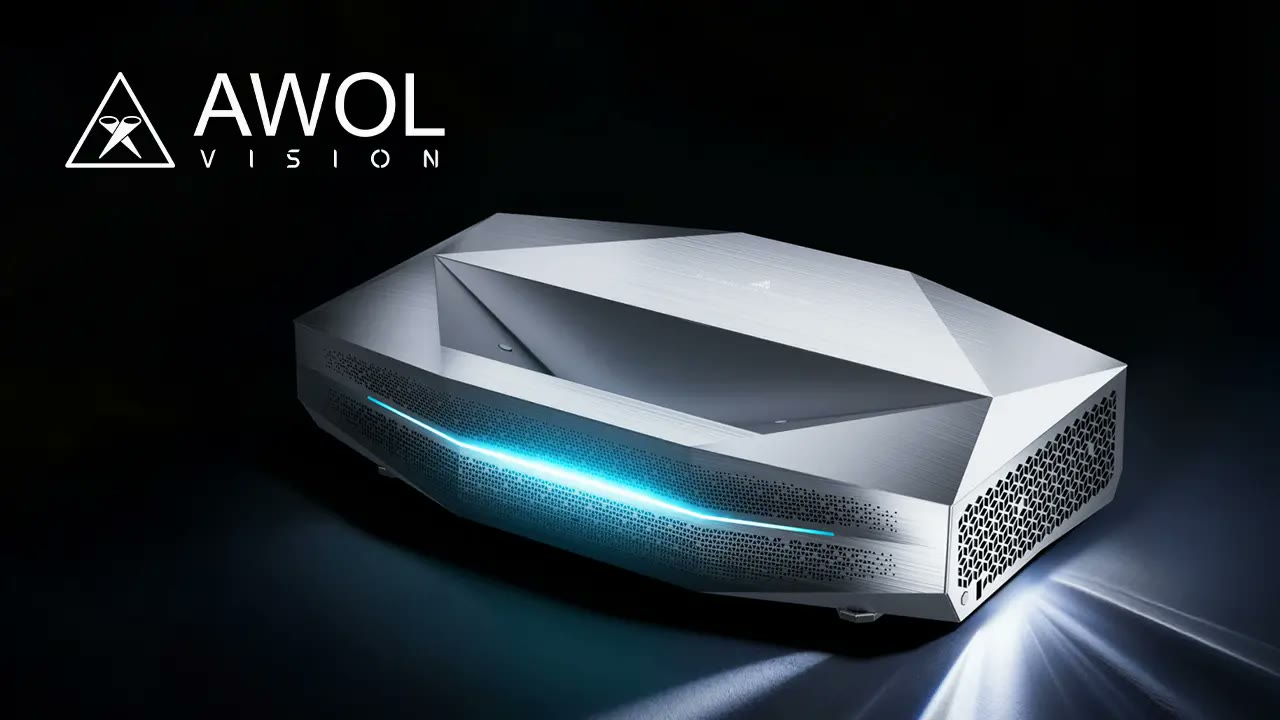
AWOL Vision Aetherion Max — the best-measured new UST. $4,499 MSRP, currently $3,899 with a promo code, triple-RGB-laser, Dolby Vision plus Dolby Vision Gaming (the first projector line marketed with it), 1 ms-class gaming latency, Google TV. ProjectorCentral measured 3,031 ANSI lumens against the 3,300 claimed and handed it a Highly Recommended award anyway; AVS Forum gave it a 2026 Top Choice. But read the measurements, not the brochure: the 60,000:1 dynamic contrast claim landed at 9,575:1–22,000:1 in testing, the practical screen size is 120–150 inches rather than the marketed 200, and the 4K/120 input displays at 60Hz. It's 19.3 lbs, a first-year product from a 2020-founded company with zero long-term reliability data, and the bundle with a proper screen runs $4,999–$6,300. Owner consensus hasn't formed yet — a well-measured newcomer, not a community-proven one.
Formovie Theater — the enthusiast's UST. Launched in 2022, and people are still daily-driving theirs in 2026 — that sentence is the whole review. The first UST to pair a triple-laser ALPD RGB+ engine with Dolby Vision, 2,800 ANSI lumens, Bowers & Wilkins-tuned audio, and a multi-hundred-post AVForums owners thread. Nobody argues about whether it's good; they argue about settings. Four years of documented annoyances: Netflix doesn't work natively (budget a streaming stick), 4K/60 max with no 120 Hz, fiddly UST geometry with no zoom. Roughly half the AWOL's money with Dolby Vision intact — the rational budget alternative, with a track record no 2026 launch can buy. One trap: the "Formovie Theater Premium" is a different, newer model — don't pay a premium for the name.
The TV counter-picks
For the "just get a TV" crowd — and it's a big, sensible crowd — three answers from the research. The LG G6 OLED (77" at $4,499 MSRP, 83" at $6,499) is the enthusiast-purist flagship: ~20% brighter than the G5 per LG, new anti-glare layer, 4K/165Hz gaming, Dolby Vision — but no HDR10+, and owners note the G4-to-G6 jump is incremental. The TCL QM8L is the value hammer: 98 inches at $5,999.99 MSRP with flagship-adjacent SQD Mini-LED tech, and the 65" has been spotted around $1,500 on deal. Ninety-eight inches of Mini-LED for the price of an Epson projector before the screen. And the Hisense 100U76N is the clearance dark horse — owner-reported deals around $1,900–$2,200 for 100 inches, though those prices are 2024-vintage and volatile. The honest framing: at $2,000–$6,000, a 98–100" TV gives you 80% of the theater scale with 100% of the convenience. The projector's remaining argument is the last 20–50 inches and the ritual.
Which one are you?
The dedicated theater builder. You have (or will build) a dark room, you own or will buy real audio, and you want the best image projection can produce. Get the JVC NZ800 at street price, budget the hush box and the screen, hire the calibrator, and stop reading reviews. If $6,000 is the ceiling, the Epson LS12000 is the consensus answer and the support story is the best in the business.
The living-room upgrader. Your room has windows, your life has Tuesdays, and you want a big image without a construction project. Get the XGIMI Horizon 20 or the Nebula X1, put it on a side table, and accept that you're trading reference color for convenience. If your room is genuinely bright, the JMGO N1S Ultimate at street price is the brightness answer — just know what you're signing up for on software.
The UST convert. You want the TV-replacement ritual: a box on the console, a screen on the wall, no ceiling mount. Get the AWOL Aetherion Max if you want the best-measured 2026 UST and Dolby Vision Gaming matters to you — and budget the ALR screen bundle, because the screen is half the purchase. Get the Formovie Theater if you'd rather have four years of owner evidence and keep two grand.
The "just get a TV" realist. You watch with the lights on, you hate fiddling, you want it to just work. Get the 98" TCL QM8L or a big LG OLED and never think about throw ratios again. This is not the consolation prize. For most living rooms, it's the correct answer, and the projector people know it.
The tinkerer on a budget. Hunt the used and refurb market — but buy the seller, not the brand. The Xiaomi Mi Smart Projector 2 Pro's documented post-warranty DLP dot failures are the cautionary tale: no service access means no safety net. Authorized channels and real return policies are the whole game.
The thing nobody says
Here's the sentence the projector industry won't print: the best home theater is matched to your room, not your budget. A $1,500 XGIMI in a dark room will move you more than a $14,000 JVC fighting afternoon sun — because projection is a system and the room is the biggest component in it. The people who love their projectors aren't the ones who bought the most projector. They're the ones who built the darkest room, bought the right screen, and sat down when the lights went out.
A hundred inches doesn't change the movie. It changes the room. Build the room first, and the projector — whichever one survives this guide — will do the rest.
Prices, specs, and community claims observed 2026-09-20; re-verify live before purchase. Anything marked UNVERIFIED above was unverifiable in the research pass — treat it as a question for your dealer, not a fact.